Publications
“The Marginal Cost of Traffic Congestion and Road Pricing: Evidence from a Natural Experiment in Beijing” (with Jun Yang and Shanjun Li)
American Economic Journal: Economic Policy, (2020) 12(1): 418-53
American Economic Journal: Economic Policy, (2020) 12(1): 418-53
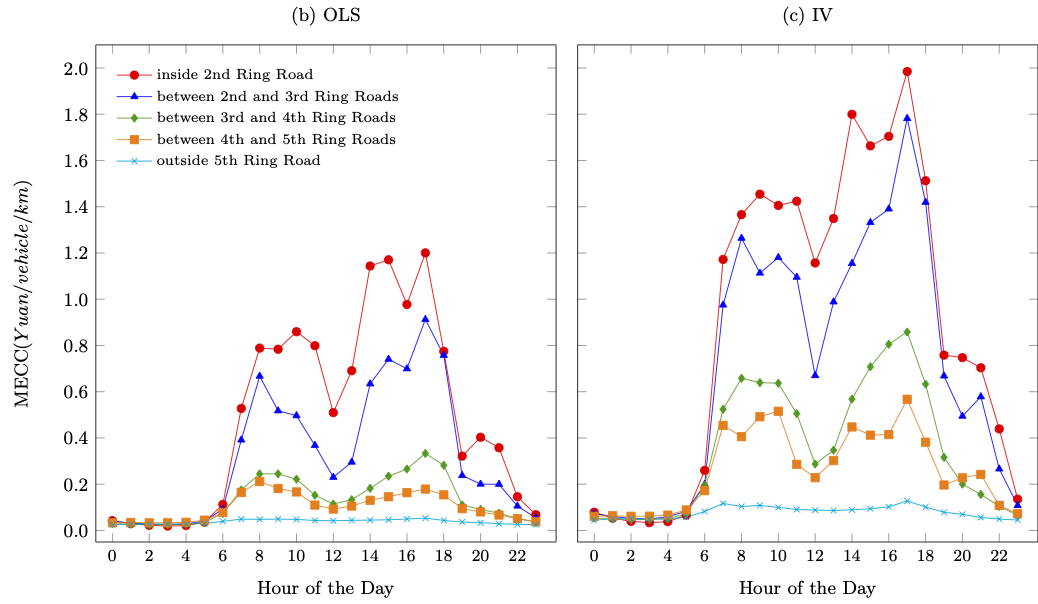
Marginal External Cost of Congestion
|
Severe traffic congestion is ubiquitous in large urban centers. This paper provides the first causal estimate of the relationship between traffic density and speed and optimal congestion charges using real-time fine-scale traffic data in Beijing. The identification relies on plausibly exogenous variation in traffic density induced by Beijing’s driving restriction policy. Optimal congestion charges range from 5 to 39 cents per km depending on time and location. Road pricing would increase traffic speed by 11 percent within the city center and lead to an annual welfare gain of 1.5 billion Yuan from reduced congestion and revenue of 10.5 billion Yuan.
|
“Does Subway Expansion Improve Air Quality?” (with Shanjun Li, Yanyan Liu, and Lin Yang)
Journal of Environmental Economics and Management, (2019) 96: 213-235
|
Major cities in China and many other fast-growing economies are expanding their subway systems in order to address worsening air pollution and traffic congestion. This paper quantifies the impact of subway expansion on air quality by leveraging fine-scale air quality data and the rapid build-out of 14 new subway lines and 252 stations in Beijing from 2008 to 2016. Our main empirical framework examines how the density of the subway network affects air quality across different locations in the city during this period. To address the potential endogenous location of subway stations, we construct an instrument based on historical subway planning, long before air pollution and traffic congestion were of concern. Our analysis shows that an increase in subway density by one standard deviation improves air quality by two percent and the result is robust to a variety of alternative specifications including the distance-based difference-in-differences method. The total discounted health benefit during a 20-year period from reduced mortality and morbidity as a result of 14 new subway lines amounts to $1.0–3.1 billion, or only 1.4–4.4 percent of the total construction and operating cost.
|
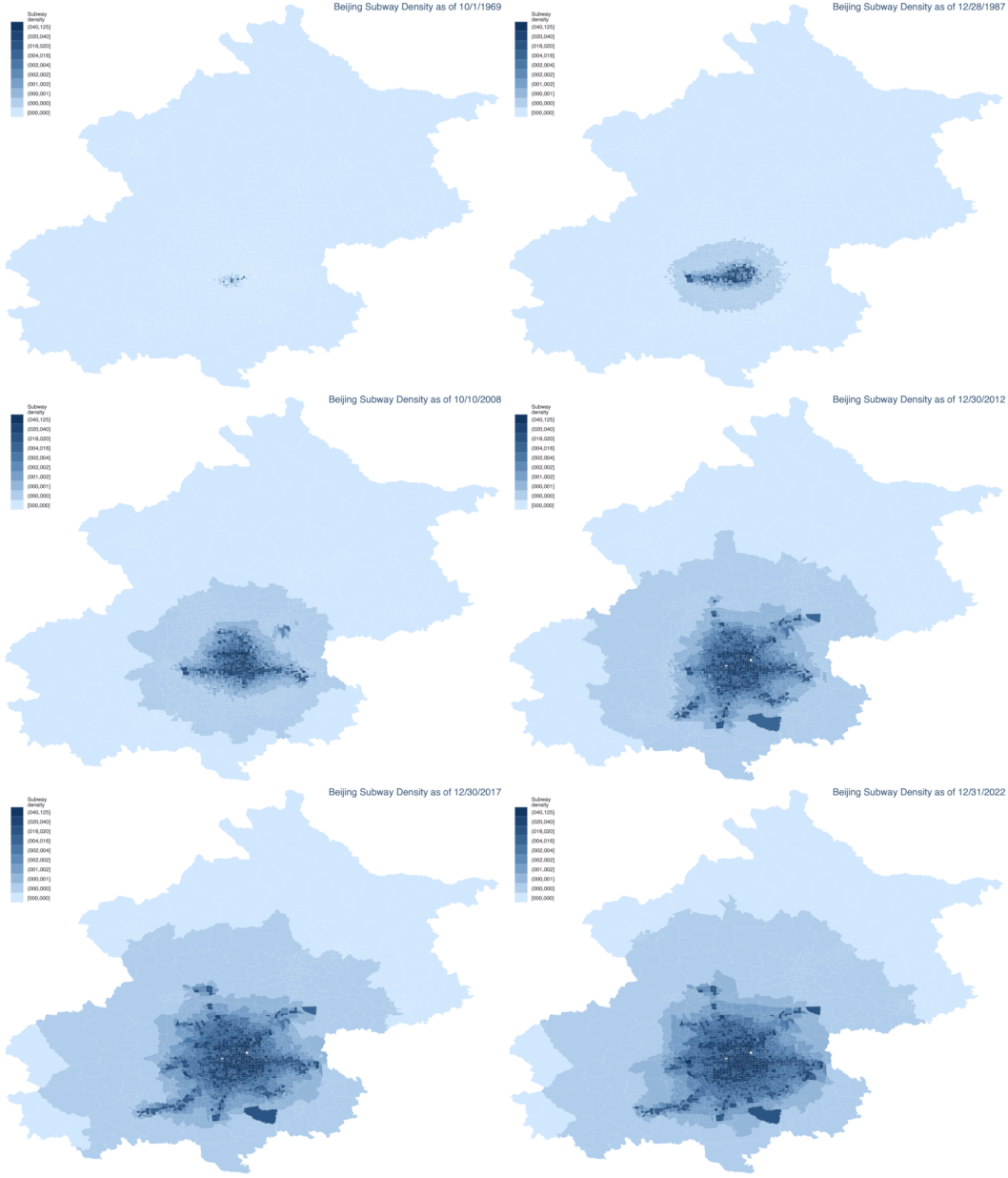
Subway Network Density in Beijing
|
Working papers
Traffic congestion and air pollution are pressing challenges facing middle-income countries. Lost time due to congestion negatively impacts growth while air pollution adversely affects public health. To address this issue, governments have pursued a host of policies including driving restrictions, public transit fare reductions, and subway expansions. However, there is limited empirical evidence regarding the relative effectiveness and efficiency of such policies in developing country settings. In this paper, I estimate the welfare effects of various congestion-reduction policies for Beijing, which has some of the world’s worst pollution and congestion problems. Specifically, I compile a detailed dataset which allows me to recover individuals' full transportation mode choice sets. I then leverage this information in a discrete choice framework to estimate consumer preferences for travel time and cost; to examine the substitution patterns among different travel modes; and to generate counterfactual simulations for travel demand, mode choice and consumer welfare under alternative transportation policies. My estimates suggest that the elasticity of driving with respect to travel cost is 0.03, a substantially more inelastic response than found in the prior literature. In addition, my simulations show that the driving restriction has had a larger impact on improving the average travel speed than other traffic congestion policies (existing or proposed), resulting in reducing cost of congestion by 17 billion yuan, or 2.6 billion dollars. Based on my model, a regulator wishing to achieve the same goal of the average speed of 42km/h could subsidize public transit by 26.7 yuan per ride; restrict 3 out of 100 drivers on the road; charge 26.3 yuan within the 3rd ring road as a cordon toll; or impose road pricing of 0.46 yuan per kilometer.
"Disentangling Drivers of Rangeland Degradation in Mongolia: Herd Size Versus Climate Over 1985-2023" (with Tumenkhusel Avrimed, Steven W. Wilcox and Christopher B. Barrett)
Rangelands are the dominant land type on Earth and support the livelihoods of roughly two billion people. Therefore it is crucial to understand the causes of rangeland degradation for both environmental and socioeconomic reasons. Using spatially disaggregated, nationwide time series data from Mongolia spanning 1985-2023, we empirically disentangle two hypothesized drivers of declines in rangeland biological productivity: herd size and climate change. We combine small area estimation and instrumental variables methods to causally identify the effects of herd size on summer grazing lands’ vegetation separately from the impacts of weather conditions on those same rangelands. Exploiting seasonal variation in the geography of grazing, we use herd exposure to severe winter weather (dzuds) on winter grazing lands as an instrument for herd size. Larger herd sizes, higher temperatures, lower precipitation and higher wind speeds each negatively and significantly impact rangeland biological productivity. Climate and weather's impacts are an order of magnitude larger than those of herd size, however, albeit less so in cooler, higher-elevation areas than in warmer, drier desert and semi-desert zones.
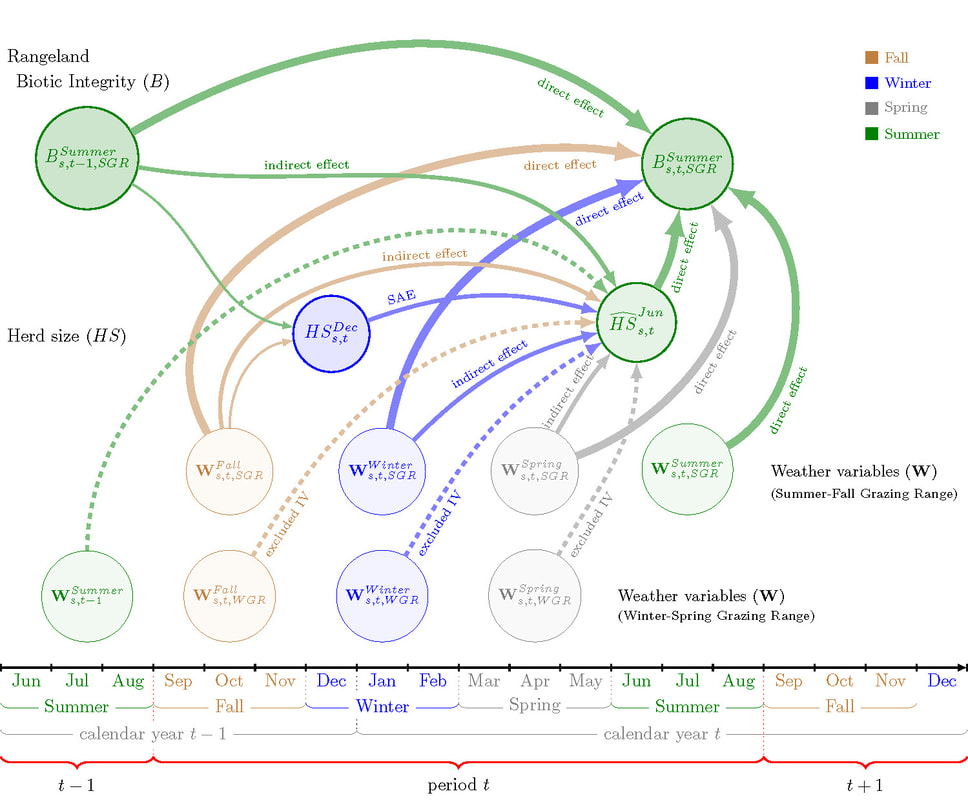
Identification Strategy
"Mongolian Grasslands and the Tragedy of the Commons" (with Martino Pelli, Jeanne Tschopp, and Yazhen Gong)
|
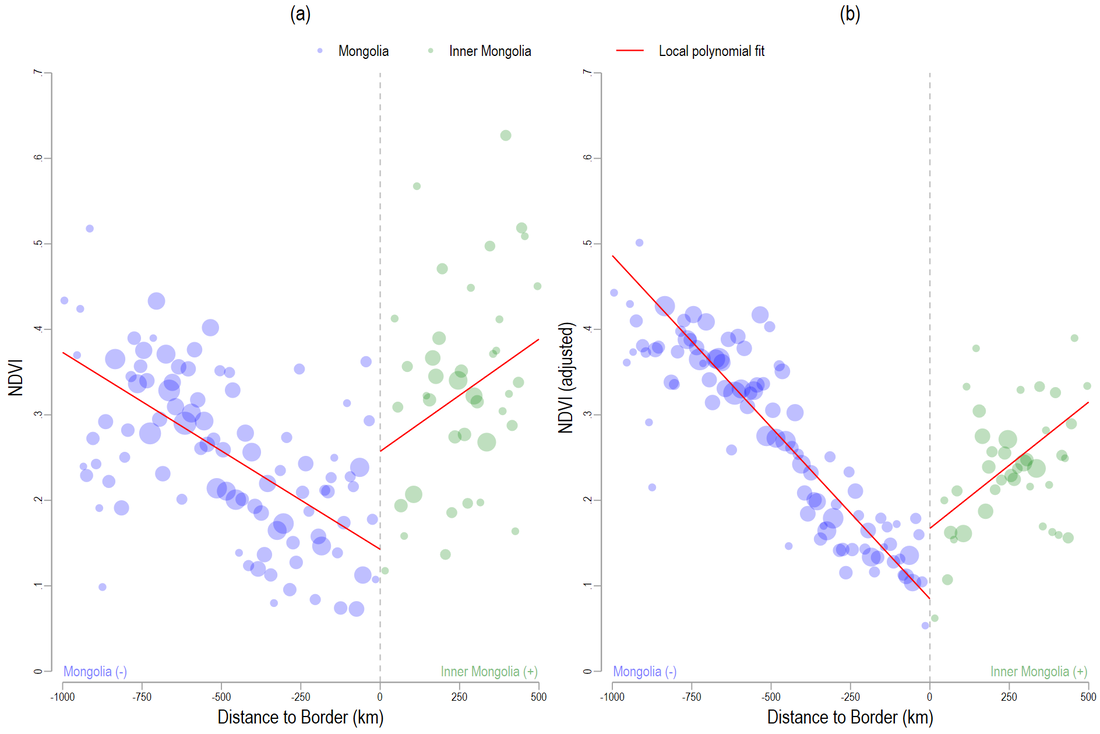
We study the impact of the Chinese grassland protection policies on the quality of the grasslands of Inner Mongolia. We measure the quality of the grasslands with the Normalized Difference Vegetation Index (NDVI) and implement a Regression Discontinuity Design using the border between Mongolia and Inner Mongolia as discontinuity. Our results suggest that the policies improved the quality by 11%.
|
We build a new database of highly spatially disaggregated indicators related to risk and resilience to the social and economic impacts of the COVID-19 pandemic in Uzbekistan. The outbreak disproportionately affects particular groups – the elderly, the poor, those living in areas under lockdown, and families who rely on remittance income are all examples of groups that are especially vulnerable to effects of the crisis in Uzbekistan. We assemble indicators summarizing concentrations of these and other risk factors at the lowest administrative level in the country, neighborhood-sized units called mahallas. Local official administrative statistics (published for the first time in this study) are combined with monthly panel survey data from the ongoing Listening to the Citizens of Uzbekistan project to produce an overall risk index, which is decomposable by dimension or risk factor to inform targeted and issue-specific responses. We then demonstrate a process for updating key indicators (such as employment or remittance flows) on a monthly basis using linked survey data combined with small area estimation techniques. These neighborhood-level results are intended to improve resource allocation decisions and are particularly relevant in Uzbekistan where local representatives are responsible for implementing key social and economic programs to respond to the outbreak.
One of the most interesting ideas in social science is the notion that individuals are motivated by concerns about their relative position. Using cross-sectional data from six transition countries, Kazakhstan, Moldova, Macedonia, Serbia, Tajikistan and Ukraine, we build on previous studies that have examined the relationship between relative position and well-being. The main novelty is that various hypotheses are tested: the importance of own consumption, the contribution of relative consumption, the relevance of social exclusion, and the marginal contribution of relative social exclusion. Most importantly, we examine the significance of “reference group” in the relationship between relative consumption and well-being. First, we begin by replicating the previous studies by testing the hypothesis that self-reported well-being (SWB) depends on relative income, with the distinction that we use relative consumption, which at a conceptual level affects well-being, rather than relative income. The result supports the relative income hypothesis. we also find evidence that relative consumption exerts a positive influence on SWB, a finding which lends support to Hirschman’s “tunnel effect” conjecture. Second, we test whether households feel worse off when they are “socially excluded” in their reference group. we find that, accounting for a household’s own consumption and relative consumption, socially excluded households are associated with lover levels of SWB. Third, we investigate whether households feel worse off when there is greater degree of social exclusion in their reference group, which we call the effect of “social solidarity,” where individuals feel worse off when others around them are socially excluded. we find strong evidence for my conjecture. Finally, we examine the question of the relevant reference group, i.e. who belongs to the reference group of each household. Does it include all the households living in the same region, or district, or settlement, if the reference group is defined by geographical area? There is suggestive evidence that households compare themselves with others in their local as well as larger regions.
Work in progress
"Market Access, Firm-level Outcomes and Misallocation of Capital in India" (with Jeanne Tschopp, and Martino Pelli)
“Does Transport Infrastructures Create Resilience to Hurricanes? Evidence from India” (with Jeanne Tschopp, and Martino Pelli)
“Roads as a Network and Congestion Pricing: Evidence from High-Frequency Traffic Data” (with Shanjun Li)
“Understanding Heterogeneity in the Value of Time” (with Ziye Zhang and Shanjun Li)
“Does Transport Infrastructures Create Resilience to Hurricanes? Evidence from India” (with Jeanne Tschopp, and Martino Pelli)
“Roads as a Network and Congestion Pricing: Evidence from High-Frequency Traffic Data” (with Shanjun Li)
“Understanding Heterogeneity in the Value of Time” (with Ziye Zhang and Shanjun Li)